
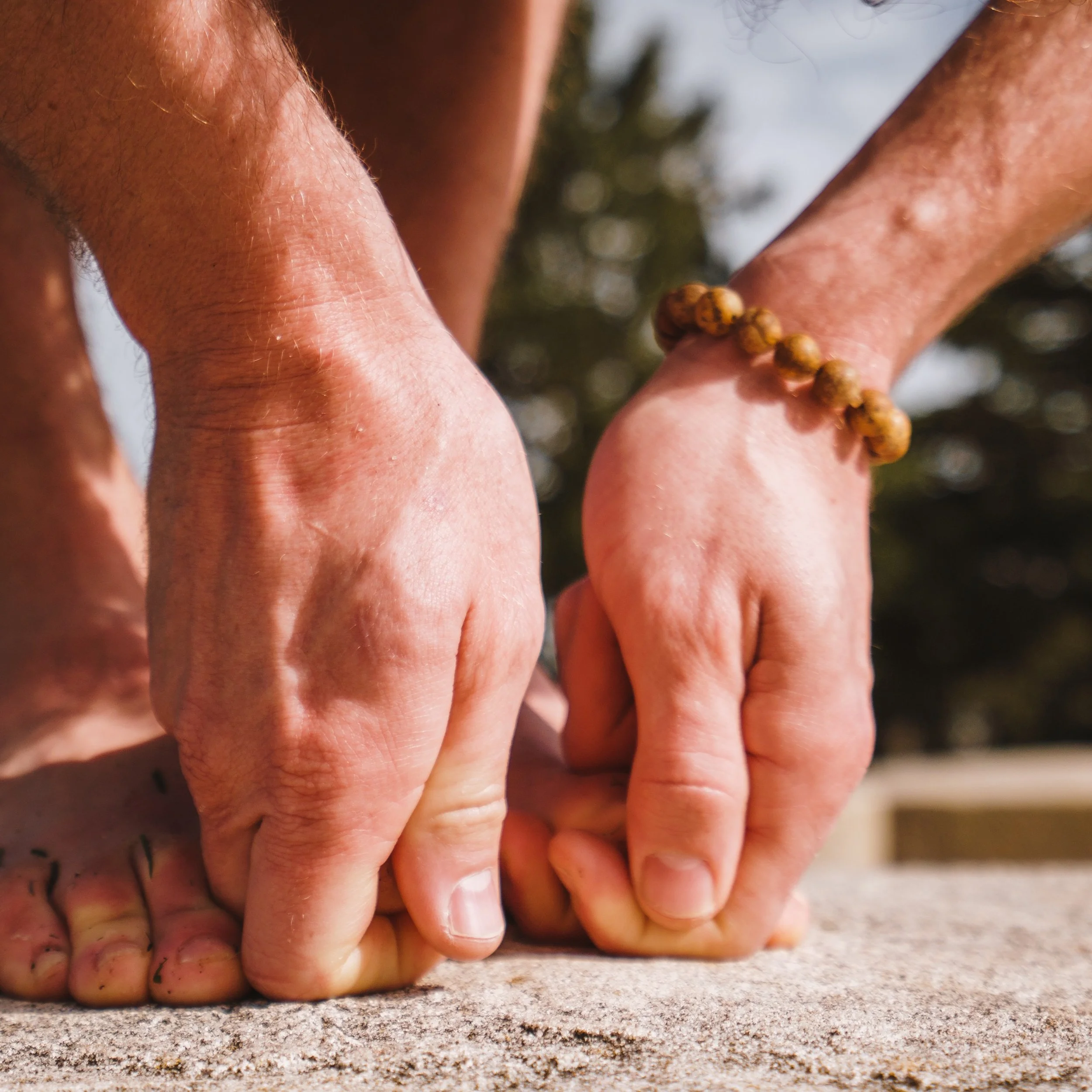
Held By Gravity is an eight-minute practice for days when you feel floaty, numb, or far away. You pick one place where you’re touching something solid: your feet on the floor, your seat on the chair, your back against a wall, or your hands on a table. You press into it and ease off, three times. You feel whether the surface is rough or smooth, warm or cool. You rock a little from side to side. Then you look around the room. There’s nothing to do with your breath.
It’s a simple practice, and there’s a fair amount behind it.
Feeling far away is ordinary.
Researchers have two words for it: depersonalization, when you feel detached from yourself, and derealization, when the world looks flat or unreal. Surveys put the share of people who’ve had a passing episode somewhere between 26 and 74 percent, often at times of stress or exhaustion. (The range is that wide because the surveys asked different questions.) The lasting, disruptive kind is much rarer, around 1 percent.
Meditation can bring it on, too. When a team at Brown University cataloged the difficult experiences of 60 meditators, the list of 59 included the world seeming “dreamlike, unreal, two-dimensional or as if in a fog.” That study went looking for trouble, so it can’t say how often this happens. It’s one reason this practice stays at the surface: floor, chair, wall.
Pushing is easier to feel than resting.
In the early 1900s, the physiologist Charles Sherrington gave a name to the sensors in your muscles and tendons that report where your body is and what it’s doing. He called them proprioceptors. The ones in your tendons signal how much force a muscle is exerting. A muscle at rest gives them little to say. Press your feet into the floor for a count of five, and they have plenty to say. The pressing turns up a signal that was already there.
You have a sense for gravity.
In your inner ear, two small organs have a membrane weighted by tiny crystals. When your head tilts, gravity shifts the membrane, and the cells underneath register it. (It’s a good part of how you know which way is up in the dark.) So “held by gravity” is a figure of speech with an organ attached.
Rocking stirs that system. In a sleep lab in Geneva, 18 young adults fell asleep faster and slept more deeply on a gently rocking bed, and in a companion study, mice with impaired inner ears got no benefit from being rocked. A small sway in a waiting room is not a night in a rocking bed. Still, people have rocked babies for a long time, and the inner ear may be part of why.
Touching the ground is an old move.
In the story of the Buddha’s awakening, Mara the tempter sends armies, then his daughters, and finally claims the seat for himself. The Buddha answers by reaching down and touching the earth, and the earth says, “I bear you witness.” It’s a myth, and statues all over Asia show that hand reaching for the ground. What I notice in the story is where the hand goes. At the hardest moment of the night, it goes to the floor.
What I can’t tell you.
Grounding is taught nearly everywhere, and as far as I can find, nobody has run a good trial on a practice like this one by itself. What I’ve given you is the reasoning, and it comes with no guarantee. If your point of contact feels faint, that might be a clue that you’re a bit checked out, or it might be how that part of you usually feels. And if the far-away feeling is with you most days, that’s worth talking over with a person.
Wherever you’re reading this, something is holding you up. Press into it for a count of five, and ease off. That’s the short version.